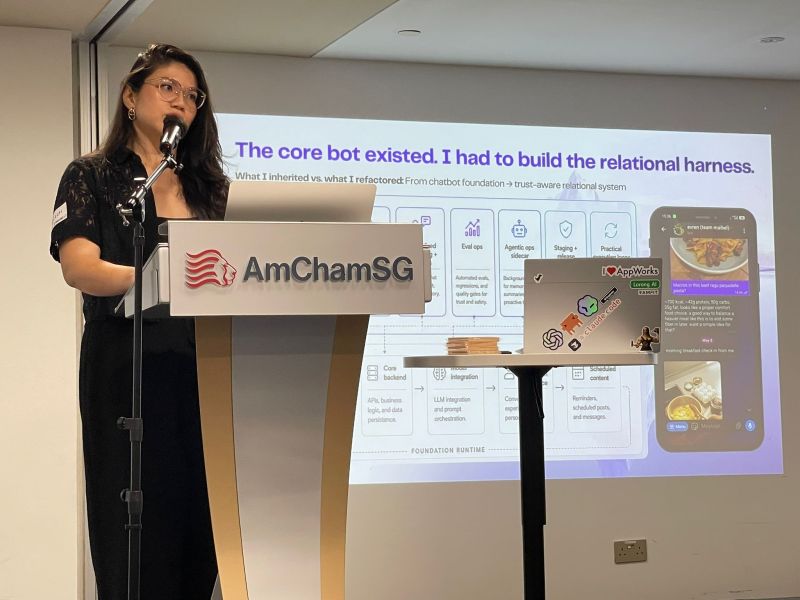
"How do you go from English lit graduate to building memory architecture, eval loops, and agent workflows?”
That was the first question I was asked after my show-and-tell for Carousell Group's first Residency cohort.
I’d just walked the room through Maibel's iceberg architecture stack.
On the surface, Maibel looks like a simple Telegram wellness companion users can talk to.
Under the hood, it’s much more complicated than the interface reveals.
Orchestration layers. Memory. Eval ops. Payment access. Coaching gates. Safety constraints. Runtime trust.
Then I showed the current team making it possible:
- 1 full-time human contributor (me)
- 1 part-time eval ops contributor
- 1 OpenClaw ops analyst
- 1 Hermes growth agent (probationary)
I didn’t become technical because I woke up one day wanting to be an AI engineer.
I became technical because I tried handing off what was in my head and kept running into translation loss.
Good engineers build what is specified.
They can’t guess the years of domain judgment I hadn't yet turned into a system.
Coaching women taught me how to read hesitation, timing, shame, resistance, readiness, and the moment support starts becoming pressure.
Maibel forced me to encode that.
An app can be designed around fixed flows: a user clicks a button, state changes, the next screen appears.
A wellness companion does not behave that neatly.
The hard part is making a probabilistic model behave inside deterministic wellness boundaries, so the outcome feels emotionally intelligent, safe, and coherent.
A user says she’s tired.
Is that a coaching moment, a stress signal, a memory recall moment, or a sign to stop pushing completely?
A good coach reads that intuitively.
Maibel has to turn that judgment into system behavior.
That's the work under the hood.
- Routing decisions.
- Emotional state classification.
- Confidence-scored memory retrieval.
- Safety cascades.
- Eval loops that catch drift before a user feels it.
Behavioral logic decides whether Evren nudges, holds back, asks one question, or changes direction entirely.
Founder life sounds more glamorous before you’re awake at 2am, pulling your hair out trying to figure out what the problem is -
Routing, prompt design, memory retrieval, state classification, or an assumption I failed to architect properly.
I couldn’t just patch over it.
A brittle fix in emotional AI doesn’t just create a UX bug.
It affects trust. And trust is my core product promise.
That’s why I joined this 12-week residency.
Maibel is entering an accelerated phase: runtime trust, paid coaching access, memory and company canon, agentic ops expansion and growth distribution.
The product is ready for monetization tests. Now my system has to catch up.
I’m building in two parallel lanes: a companion my users see, and an agentic system underneath that makes it possible.
My hypothesis is simple:
AI-native startups won’t just build AI products.
They’ll be driven by lean AI-native teams.

Hi, I’m Mabel.
I’m the founder of Maibel. I write about emotional AI, women’s wellness and learning to build the things I wish existed.
More about me