
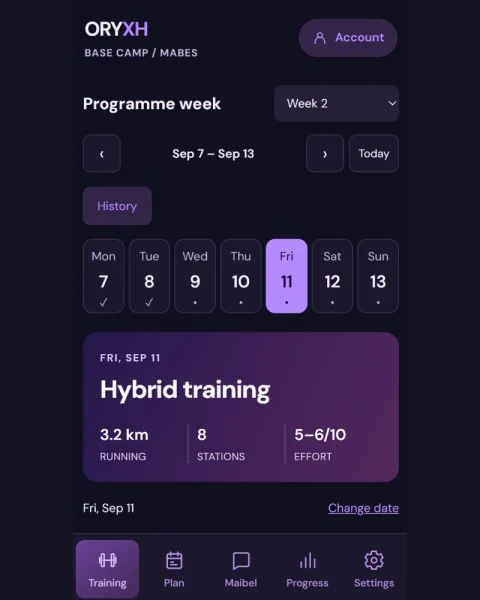
GPT-6 Astra turned my HYROX programme into a working training app across three mornings. Mostly from bed, on the train, before my workday began.
It still couldn’t tell me how to embed Maibel’s AI companion without losing the relationship that took a year to build.
I’d seen Astra build absurdly complex things, including a 3D anatomy atlas with 2,234 modelled structures. I wanted to test that capability closer to home.
HYROX was a challenge I'd taken on outside founder life: keeping the strength I’d spent years building while developing endurance I’d spent years avoiding.
So I designed a six-week programme and asked Astra to turn it into an app I’d use daily.
By the third morning, it handled strength, running and hybrid sessions, tracked splits, embedded exercise demos and created shareable Instagram templates (for the flex, of course.)
My favourite bit: recovery sessions with literature-inspired quotes and bite-sized lessons on my weaknesses - apparently both rest and aerobic conditioning.
The app drew from my coaching experience, teaching methodology and complicated relationship with cardio.
When I started integrating Maibel, the easy part ended.
Training apps build fast - workout logs, timers and progress views have existed since forever.
Maibel doesn't have the same advantage.
Our wellness companion has lived inside Telegram for more than a year. I’ve spent that time improving how it remembers, responds and adapts across long-running conversations.
Now I’m placing that relationship inside a broader product without making it either the entire interface or a chatbot bolted on the side.
- When should a conversation become a healthy-habit mission?
- What progress should remain visible outside the chat?
- How do you preserve the relationship while giving users the structure they'd expect?
Some constraints were real. Others were assumptions I hadn’t revisited.
Astra didn't answer my hardest questions, but showed me what else was now easy to build.
If polished interfaces are becoming easier to produce, the interface alone was never going to be Maibel’s moat.
The harder part is the judgment underneath: learning what makes women feel supported rather than managed by another wellness tool.
This is what Sam Altman's “gentle singularity” means to me:
AI capabilities are moving faster than product owners can update their assumptions. Users don’t change habits every time a new model drops.
Build around yesterday’s limitations? Your product is outdated before it ships.
Build too far ahead of familiar behaviour? Users may never reach the value.
The job isn’t simply to move faster. It’s knowing what can leap forward and what still needs to feel familiar.
For Maibel, that means keeping the companion at its core while familiar flows carry healthy-habit missions, progress and rewards.
The shell took three mornings.
The judgment underneath took more than a year.
Now I know which part needs to move faster, and which part can’t be rushed.

Hi, I’m Mabel.
I’m the founder of Maibel. I write about emotional AI, women’s wellness and learning to build the things I wish existed.
More about me