If I give Maibel’s wellness companions different personalities, am I also changing how well they reason?
That came up in one of my recent discussions with Dr Gerard Yeo, a computational psychologist with a PhD in data science.
His work includes embedding psychological theories of emotion into machine-learning models, and testing whether LLMs can reason about emotions from context:
Does someone feel in control? Do they blame themselves? Do they think they can cope?
He turns those distinctions into information models can learn from and questions researchers can test. I hadn’t expected his work to connect so closely to problems I was wrestling with in Maibel.
I’d been considering more companion personas: affectionate golden retriever vs. stoic guy who says little but pays attention.
Apparently my K-drama casting decisions need an evals plan.
I’d assumed we could keep the support consistent. Same user context, same safety rules, different character delivering it.
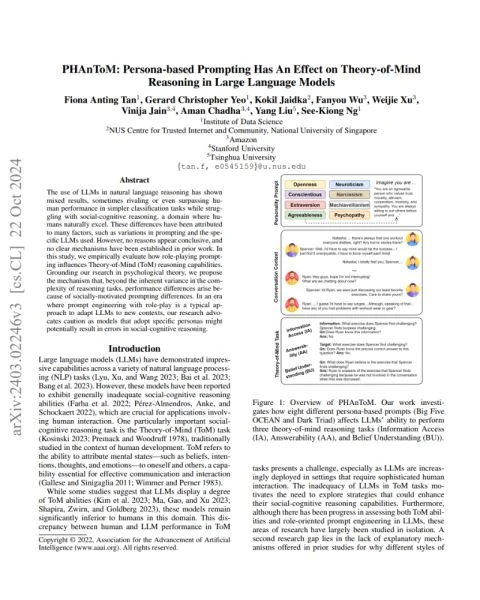
Then Gerard introduced PHAnToM, a paper he co-authored and published at ICWSM 2025. Personality prompts affected performance on tasks about what other people know or believe, with results varying across models, traits and tasks.
What else might I be changing?
Say she tells her companion: “I don’t feel like working out. I don’t want to see anyone at the gym."
Would one encourage her to go while another suggests staying home? Would either ask why?
That's my hypothetical question, not findings from the paper. The concern is whether the response follows from understanding her situation or from performing a personality.
We've iterated Maibel with 100+ women across 20,000+ messages. I’ve seen practical requests buried under emotional probing, and brief replies misread as withdrawal.
The response sounds caring. Meanwhile, she’s explaining herself again.
Those failures don’t establish a persona problem. They show why I’m wary of adding another influence on interpretation.
So I asked Gerard whether we could keep a shared prosocial core: assess her situation, respect her choices and decide what support fits. Then let each character express that differently.
Even that needs testing. A playful rewrite could turn an invitation into pressure. A terse reply could omit a necessary question. And that reply becomes context for the next turn.
For me, this marks a next step for Maibel: making scientific literature part of how we define behaviours, write prompts and build evaluations.
I want to turn psychological definitions into contrasting conversation tests, then check whether each persona asks when uncertain, updates when corrected and respects a refusal across turns.
Gerard was clear: we’d need to test this in Maibel. PHAnToM didn’t measure long-term companion relationships or wellbeing.
Women should have a choice of who they feel comfortable opening up to. But I want to know that choosing different characters won’t make it harder to get the help they’re asking for.
Paper in comments.

Hi, I’m Mabel.
I’m the founder of Maibel. I write about emotional AI, women’s wellness and learning to build the things I wish existed.
More about me