94% of psychologists say today’s chatbots can’t treat mental-health conditions with enough clinical nuance.
People are using them anyway.
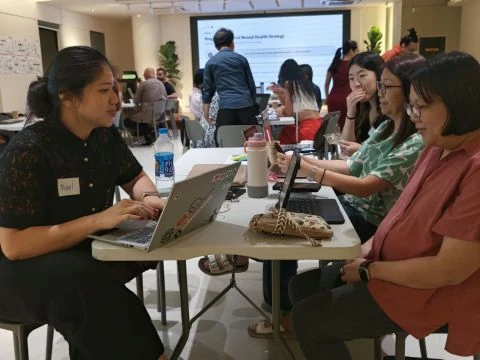
Last week I sat in Lorong AI's first Mental Health Paper Club organised around a question that sits at the centre of what I’m building:
Where should AI actually sit in the mental-health support system?
Singapore’s national strategy spans wellbeing promotion, early support, treatment and specialist care. We were asked where AI belongs.
I left thinking the four tiers may be more useful for defining what AI can do as risk changes, rather than deciding where AI permanently belongs.
Earlier this year, Ministry of Health (Singapore) said AI chatbots had become so ubiquitous that it was no longer practical to track their use for counselling or mental-health support.
On mindline.sg alone, more than 795,000 mental-health self-help exercises have been completed.
I encountered the access problem long before building AI.
As an educator, I worked with students at risk who sometimes needed professional support well before it became available. The referral could be appropriate, but capacity simply wasn’t there yet.
That complicates how we talk about safety.
For someone facing long waits, cost or stigma, AI isn’t necessarily replacing an available therapist. It may be filling a period when little other support is available.
Grace Koh also raised an important distinction: immediate relief has value, but relief and deeper therapeutic change are different outcomes.
Another participant with Child Protection experience highlighted a different problem: across repeated calls about the same family, different professionals often hold only part of the history.
Under heavy caseloads, relevant context gets lost.
AI could help preserve those traces, organise case histories and surface relevant information before a professional makes the judgment.
I later spoke with a certified counsellor and former social worker who raised an important point: distinguishing one terrible day from a pattern that genuinely warrants professional intervention often requires longitudinal context.
That informs how I’m designing our companion system.
Maibel is an emotionally intelligent AI wellness companion for women. I’m deliberately NOT building a therapist or diagnostic system.
But users don't keep their lives inside clean product categories.
Sleep problems, work stress, disrupted routines or a missed workout can sit alongside something more serious. If those signals persist or deepen over time, the companion's role should change too.
As Maibel explores wellbeing pilots with female-dominant workforces, that boundary is becoming part of the product design itself.
Relational AI can provide continuity where human care has gaps. That same continuity creates a responsibility to recognise when everyday wellness support is no longer enough.
A good companion needs to understand the limits of the role it has been trusted to play.

Hi, I’m Mabel.
I’m the founder of Maibel. I write about emotional AI, women’s wellness and learning to build the things I wish existed.
More about me